OKX Wallet vs MetaMask: Which Wallet Should You Use?
Published October 31, 2026 · okxapk
Self-custody wallet for 140+ networks, with a built-in DEX. Joining through our invite link gives a trading-fee discount on OKX DEX swaps.
Open OKX WalletReferral link: we may earn a share of DEX fees at no extra cost to you.
OKX Wallet and MetaMask are both self-custody (non-custodial) crypto wallets: you hold the keys, and nobody can recover a seed phrase you lose. The main differences are reach and cost. OKX Wallet covers 140+ networks, shows its swap fee per trade (zero for some tokens) and connects to an OKX exchange account. MetaMask focuses on Ethereum and other EVM networks, now also supports Solana, Bitcoin, TRON and Stellar, and charges a 0.875% MetaMask fee on its built-in swaps. If you already use OKX or trade on many chains, OKX Wallet is the more convenient choice; if you mostly use Ethereum DApps, MetaMask is the long-standing option.
| OKX Wallet | MetaMask | |
| Custody | Self-custody: you hold the keys | Self-custody: you hold the keys |
| Networks | 140+ networks, including Bitcoin, EVM chains, Solana and Sui | EVM networks plus Solana, Bitcoin, TRON and Stellar |
| Built-in swap fee | Shown on the confirmation screen; can be zero for some tokens | 0.875% MetaMask fee on Swaps, plus network gas |
| Social login | Google, Apple or email | Google, Apple or Telegram |
| Hardware wallets | Keystone, OneKey and others | Ledger, Trezor and others (Ledger: EVM accounts only) |
| Exchange link | Connects to an OKX exchange account | No exchange account; buy and sell through partner providers |
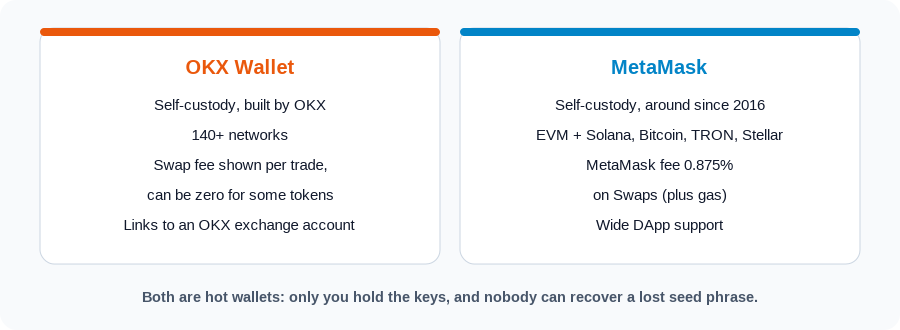
Both wallets are self-custodial. Your funds are controlled by a private key derived from your seed phrase (MetaMask calls it a Secret Recovery Phrase), and that key stays on your device. This is different from an exchange account, where the company holds the keys for you.
Both are also hot wallets: the keys live on a phone or computer that is online. For larger amounts, both let you connect a hardware wallet so the keys stay on a separate device.
This is where the two wallets differ the most in history. MetaMask began as an Ethereum wallet and still works with any EVM network you add. Its help center now lists Solana, Bitcoin, TRON and Stellar as well: when you create a MetaMask account, it automatically generates EVM, Bitcoin and Solana addresses from the same recovery phrase.
OKX Wallet was built multichain from the start. OKX says it supports 140+ networks, and its Chrome Web Store listing names Bitcoin, Ethereum and other EVM networks, Solana and Sui. If you hold tokens on less common chains, OKX Wallet is more likely to show them in one place without manual setup.
Both wallets have a built-in swap that searches several DEXs for a quote. The cost structure is different:
On a $1,000 swap, a 0.875% fee is $8.75 before gas. Always compare the final amount you receive on the confirmation screen, because price impact and gas can matter more than the fee on small or illiquid trades.
Both wallets let you create a classic seed phrase wallet or import one you already have. Both now also offer a social login so beginners do not have to write down a phrase on day one:
In both cases, losing access to the social account and the password can mean losing access to the wallet, so treat them as carefully as a seed phrase.
MetaMask connects to Ledger and Trezor devices, among others. Its help center notes that only EVM-based Ledger accounts can be connected. OKX Wallet supports hardware wallets such as Keystone and OneKey, and you approve each transaction on the device.
On safety, OKX Wallet's store listing mentions phishing detection and risk warnings for suspicious sites and transactions, and the wallet has an Approvals page where you can revoke token approvals. MetaMask's help center has detailed guides on signature phishing, address poisoning and clipboard hacking. Whichever you choose, the biggest risks are the same: fake extensions, fake "support" chats, and signing approvals you do not understand.
OKX Wallet can be connected to an OKX exchange account, which lets you move crypto between the exchange and your wallet with fewer steps (for example, choosing OKX Wallet as the withdrawal destination). MetaMask has no exchange account of its own; it offers buying and selling through partner providers, where availability depends on your country.
One warning if you use both: you can import the same seed phrase into both wallets, but every extra app that holds the phrase is another place it can leak. Keeping separate wallets for separate purposes limits the damage if one is compromised.
If you want to try OKX Wallet's DEX, you can open it through our OKX Wallet referral link (we may earn a commission; the invite can give a 0–10% DEX trading fee discount depending on the code).
OKX Wallet is a self-custody wallet: OKX does not hold your keys, and only you can move your funds. That also means nobody can recover a lost seed phrase. Install it only from the official store listing that links to web3.okx.com, and never share your phrase.
It depends on what you do. OKX Wallet supports more networks and can have lower swap fees on some tokens; MetaMask is a long-standing choice for Ethereum DApps. Neither is better for everyone.
You can send crypto from OKX Wallet to another address or to an exchange. To turn it into cash, you usually send it to an exchange account, sell it there and withdraw to your bank, subject to that exchange's rules in your country.
MetaMask is a self-custodial wallet, not an exchange. Its built-in Swaps feature routes trades through DEXs and other providers and charges a 0.875% MetaMask fee plus gas.
Self-custody wallet for 140+ networks, with a built-in DEX. Joining through our invite link gives a trading-fee discount on OKX DEX swaps.
Open OKX WalletReferral link: we may earn a share of DEX fees at no extra cost to you.